How Virtual Security Guards Support Gated Community Access
Gated communities manage many different types of access every day.
Residents arrive in familiar vehicles. Visitors come to see family and friends. Vendors perform scheduled work. Delivery drivers need temporary access. Contractors may arrive after hours.
Technology can support many of these situations, but not every arrival fits neatly into an automated workflow.
That is where Virtual Security Guards can support gated community access.
By adding live remote communication to the property’s existing access-control process, communities can create a clearer path for both routine requests and exceptions.
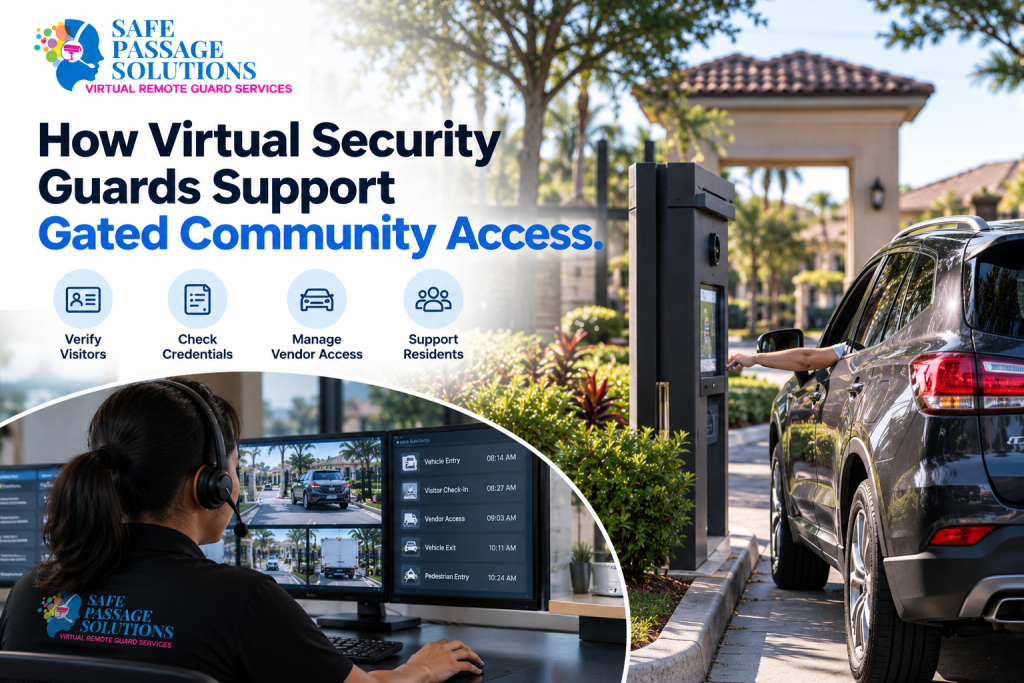
Gated Community Access Requires More Than a Gate
A physical gate controls the entrance, but the larger access process must answer several questions.
For example:
Who is requesting access?
Where is the visitor going?
Is the arrival expected?
Is the resident or vendor record current?
Does the visitor information match?
Is another confirmation step required?
What happens when authorization cannot be confirmed?
ASIS International explains that access control includes both technology and the policies and procedures that support it.
ASIS International — Getting Visitor Management Right in Access Control
For gated communities, that means access technology works best when the community already has clearly defined procedures.
Virtual Security Guards Add Live Communication
Virtual Security Guards can provide live remote communication through compatible gate technology.
Depending on the community’s approved procedures, Safe Passage Solutions remote attendants may:
Communicate with arriving visitors
Review available access information
Confirm the stated destination
Confirm the stated purpose
Contact designated parties
Follow approved property instructions
Apply defined exception procedures
Escalate unresolved requests
The property establishes the authorization rules.
The Virtual Security Guard follows those approved procedures.
This allows the community to maintain control over its access policies while still providing live support when needed.
Automation Can Support Routine Resident Access
Some access requests are predictable.
Residents may use:
License Plate Recognition
RFID credentials
Mobile access credentials
Access cards
Gate remotes
When the credential is active and the record is current, the normal resident-access process can continue without additional interaction.
For example:
Resident vehicle arrives → credential is recognized → approved resident workflow follows
Virtual Security Guards do not need to replace that automation.
Instead, they can support the situations where automation does not provide enough information.
Visitor Access Often Requires More Context
Visitors may arrive:
Earlier than expected
Later than expected
In another vehicle
Without a current visitor record
With information that differs from the property’s records
These situations do not automatically mean the visitor is unauthorized.
They mean the normal workflow may need another step.
Virtual Security Guards can provide live communication and follow the property’s approved verification or escalation procedure.
Visitor Management Can Support Expected Arrivals
Visitor Management can provide useful information before a visitor reaches the entrance.
Depending on the property setup, records may include:
Visitor name
Resident destination
Expected arrival period
Vendor or company
Authorized contact
Approved instructions
This can make visitor processing more organized.
Instead of beginning every interaction without context, the Virtual Security Guard can compare the arriving visitor’s information with what is already available.
Current Authorization Matters
Any access-control system depends on accurate records.
Communities should review credentials when:
A resident moves
A vehicle changes
A lease ends
A vendor relationship ends
Temporary authorization expires
Household access changes
NIST’s physical-access guidance emphasizes maintaining current authorized-access records and removing access when it is no longer required.
NIST SP 800-53 Rev. 5 — Physical Access Control
NIST guidance is written for organizational facilities rather than residential communities, but the broader principle is directly relevant:
access should remain tied to current authorization.
A Layered Access Strategy
Access Situation | Possible Process |
Resident with current credential | LPR, RFID, or other resident workflow |
Expected visitor | Visitor Management |
Delivery driver | Delivery procedure + Virtual Security Guard when needed |
Recurring vendor | Current vendor authorization |
Changed or unexpected arrival | Virtual Security Guard exception process |
After-hours request | Property-specific procedure |
Authorization unresolved | Escalation |
This approach gives each part of the access strategy a clear role.
Why Property-Specific Procedures Matter
The Foundation for Community Association Research emphasizes that security practices should reflect the individual community rather than assume one solution works everywhere.
Foundation for Community Association Research — Community Security Best Practices
A large master-planned community may need a very different workflow from a smaller condominium development.
The technology may be similar.
The access procedures may not be.
Frequently Asked Questions
What are Virtual Security Guards?
Virtual Security Guards are live remote personnel who can communicate with visitors and support property-approved access procedures through compatible gate technology.
Can Virtual Security Guards replace automated access?
Not necessarily. They can work alongside LPR, RFID, Visitor Management, and other credential systems.
Can Virtual Security Guards handle unexpected visitors?
They can provide live communication and follow the property’s approved exception procedure.
Do Virtual Security Guards independently decide who enters?
No. The property establishes the authorization and escalation procedures.
Can Virtual Security Guards support after-hours access?
Yes, depending on the property’s procedures and service arrangement.
Key Takeaways
Gated community access involves residents, visitors, vendors, deliveries, and exceptions.
Virtual Security Guards add live communication to the access process.
Routine resident access can remain automated.
Visitor Management can organize expected-arrival information.
Current credentials and authorization records are essential.
Virtual Security Guards follow property-approved procedures.
A layered strategy can make gated community access more organized.
Final Thoughts
Gated community access should not depend on one technology to handle every situation.
Routine resident access may be automated.
Visitor Management can support expected arrivals.
Virtual Security Guards can provide live interaction when the normal process reaches an exception.
Together, those elements can support a more organized and adaptable access-control strategy.
Safe Passage Solutions can help communities evaluate how Virtual Remote Guard, Visitor Management, License Plate Recognition, and RFID Access Control may support gated community access.
Join the Conversation
Share Your Thoughts
Related Articles
Why Virtual Security Guards Matter for Modern Access Control
Discover the importance of Virtual Security Guards in modern security systems, complementing technology for better access management.
Virtual Security Guards for More Consistent Visitor Management
Improve your property's visitor management system with Virtual Security Guards by ensuring consistency in handling guests and vendors.