Why Virtual Security Guards Matter for Modern Access Control

Modern access control is becoming more connected.
Properties may use License Plate Recognition, RFID, Visitor Management, cameras, automated gates, and other credential technologies.
But automation does not remove the need for human interaction.
A visitor may not be listed.
A resident may change vehicles.
A contractor may send another technician.
A delivery driver may arrive when the resident does not respond.
That is why Virtual Security Guards can still matter in a modern access-control strategy.
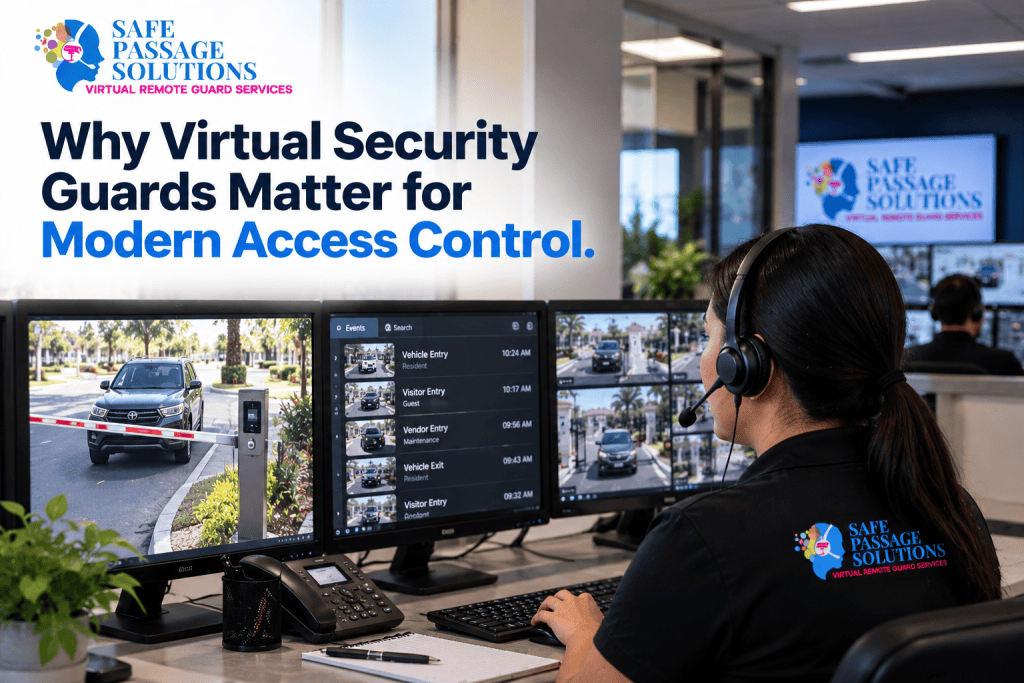
Modern Access Control Is a Combination of Tools
Access control should not be viewed as a single device.
A property may use several technologies at once:
LPR for approved resident vehicles
RFID for routine credentialed access
Visitor Management for expected guests
Automated gates for controlled entry
Virtual Security Guards for live interaction
Each tool has a different role.
The strongest strategy is to define what each component should do.
Automation Works Best With Predictable Requests
Automation is especially useful when information is clear.
Examples include:
Active resident credential
Current license plate record
Expected visitor
Approved vendor schedule
In these situations, the property already has the information needed to follow its standard workflow.
The challenge begins when something changes.
Virtual Security Guards Support the Exceptions
Real access requests are not always predictable.
Examples may include:
New resident vehicle
Rental car
Unlisted visitor
Changed vendor representative
After-hours contractor
Delivery driver needing assistance
Virtual Security Guards can provide live communication when the automated workflow cannot resolve the request.
Depending on approved property procedures, remote attendants may:
Communicate with the arriving person
Review available information
Confirm the destination
Contact a designated party
Follow exception procedures
Escalate unresolved requests
This gives modern access-control systems a live layer when more context is required.
Modern Does Not Mean Fully Automated
It can be tempting to think that modern access control should eliminate human interaction.
That is not always practical.
A well-designed access strategy may automate predictable requests while reserving live communication for situations that need judgment within established procedures.
ASIS International emphasizes that access control includes the policies and procedures surrounding access technology.
ASIS International — Visitor Management and Access Control
That supports an important principle:
Modern access control is not just about adding more technology. It is about improving the workflow.
Visitor Management Supports Better Context
Visitor Management can provide useful information before someone reaches the gate.
For example:
Visitor name
Destination
Expected arrival period
Vendor company
Authorized contact
Property instructions
That gives Virtual Security Guards more context during the live interaction.
Instead of treating every arrival as an unknown request, the attendant can compare what the visitor says with the available record.
License Plate Recognition Can Support Vehicle Access
LPR can help communities manage resident vehicles.
A community may associate an approved resident vehicle with a license plate.
A typical workflow may be:
Vehicle arrives → plate is recognized → current record is checked → approved resident procedure follows
But LPR should not be expected to resolve every situation.
A resident may use another vehicle.
A plate may change.
A temporary vehicle may arrive.
That is where a live exception process can become valuable.
RFID Still Has a Role
Modern access control does not require communities to abandon existing credential systems.
RFID may still support:
Existing resident access
Assigned tags
Specific vehicle lanes
Backup credential methods
Property-specific workflows
ALPR and RFID can coexist.
The best system is the one that fits the property’s actual needs.
Current Records Support Reliable Access
NIST emphasizes that authorization records should remain current and access should be removed when no longer required.
Again, NIST is not written specifically for residential HOAs, but its principle is useful for modern access control:
technology cannot compensate for outdated authorization records.
Communities should review:
Resident credentials
Vehicle records
Vendor authorizations
Temporary permissions
Visitor records
Contact information
A Modern Access-Control Framework
Access Need | Possible Technology or Process |
Routine resident vehicle | LPR or RFID |
Expected guest | Visitor Management |
Routine vendor | Current vendor authorization |
Changed information | Virtual Security Guard interaction |
After-hours access | Property-specific procedure |
Authorization unresolved | Escalation |
This layered model allows automation and live support to complement each other.
Community Requirements Should Drive the Strategy
The Foundation for Community Association Research provides best-practice resources specifically for community associations and emphasizes that security planning should reflect each property’s unique characteristics.
Foundation for Community Association Research — Community Security
A property with frequent vendor traffic may need a different setup from one with mostly resident and guest traffic.
A large gated development may need a different strategy from a small residential association.
Frequently Asked Questions
Why do Virtual Security Guards matter if the property has automation?
Automation cannot resolve every real-world access request. Virtual Security Guards can provide live communication when additional context is needed.
Can Virtual Security Guards work with LPR?
Yes. LPR can support vehicle recognition while Virtual Security Guards support exceptions.
Can Virtual Security Guards work with RFID?
Yes. RFID can handle routine credentials while remote attendants support visitor or exception workflows.
Does modern access control mean fully automated access?
No. A modern strategy may combine automation with live remote support.
Can Virtual Security Guards make independent authorization decisions?
No. The property establishes the authorization rules and remote attendants follow those approved procedures.
Key Takeaways
Modern access control often combines several technologies.
Automation works best for predictable requests.
Virtual Security Guards can support exceptions requiring live communication.
Visitor Management adds useful context.
LPR and RFID can coexist.
Current records remain essential.
Property-specific procedures should guide the technology.
Final Thoughts
Modern access control is not about replacing people with technology.
It is about assigning the right role to each part of the system.
Automation can handle predictable resident access.
Visitor Management can organize expected arrivals.
Virtual Security Guards can provide live communication when a request requires additional context.
That combination can create a more flexible and practical access-control strategy.
Safe Passage Solutions can help communities evaluate how Virtual Remote Guard, Visitor Management, License Plate Recognition, and RFID Access Control may support modern residential access control.
Join the Conversation
Share Your Thoughts
Related Articles

How Virtual Security Guards Support Gated Community Access
Find out how Virtual Security Guards can transform your gated community's access process and improve security protocols.

Virtual Security Guards for More Consistent Visitor Management
Improve your property's visitor management system with Virtual Security Guards by ensuring consistency in handling guests and vendors.