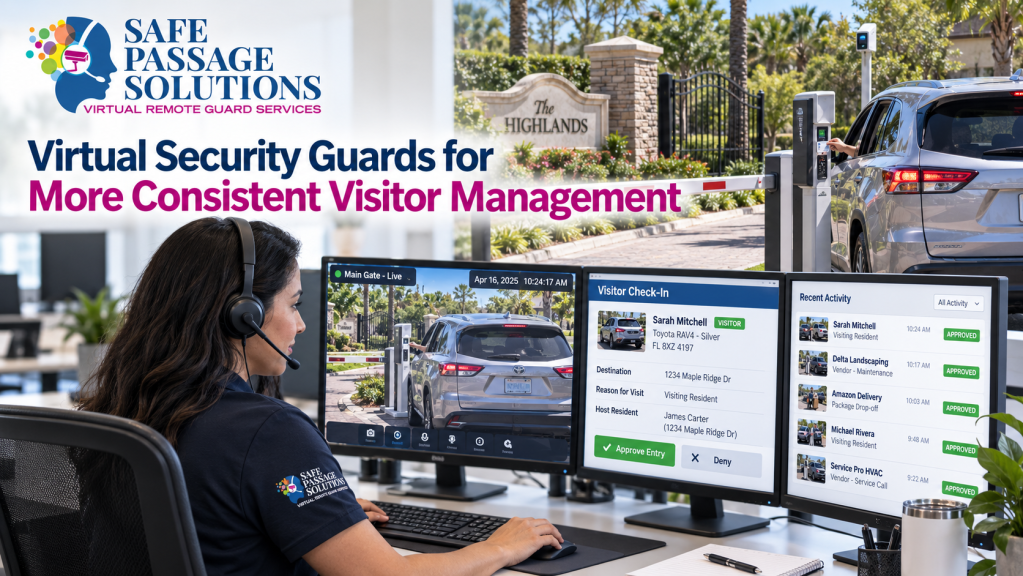
Virtual Security Guards for More Consistent Visitor Management

Visitor management works best when people know what to expect.
Residents should understand how their guests are handled.
Vendors should know what information is required.
Property managers should know what happens when records do not match.
And the gate should have a defined process for exceptions.
Virtual Security Guards can support more consistent visitor management by applying approved property procedures during live gate interactions.
Consistency Begins With Clear Visitor Categories
Not every visitor needs the same process.
Common categories may include:
Personal guests
Delivery drivers
Vendors
Contractors
Caregivers
Real estate professionals
Maintenance technicians
After-hours service providers
ASIS International notes that visitor management can be challenging because visitor categories have different access needs, durations, and procedures.
ASIS International — Getting Visitor Management Right in Access Control
A consistent process should therefore mean:
the correct procedure is applied to the correct visitor type.
It does not mean treating every visitor identically.
Visitor Management Organizes the Information
Visitor Management can provide a consistent source of expected-arrival information.
Depending on the property, records may include:
Visitor name
Destination
Expected arrival window
Vendor or company
Authorized contact
Access instructions
That information can support the live verification process.
For example:
Expected visitor + matching information → standard workflow
Information differs → exception process
Authorization unresolved → escalation
Virtual Security Guards Can Apply the Procedure
When an arrival requires live interaction, Virtual Security Guards can support the next step.
Depending on the community’s approved procedures, remote attendants may:
Communicate with the visitor
Review available information
Confirm the stated destination
Confirm the stated purpose
Contact designated parties
Follow visitor or vendor instructions
Apply exception procedures
Escalate unresolved requests
The value comes from applying a defined process consistently.
Similar Situations Should Follow Similar Procedures
Consider two unlisted visitors arriving on different days.
If one is immediately allowed through while the other goes through several verification steps, residents may see the process as inconsistent.
A better approach is:
same visitor category + same type of exception → same approved process
That does not guarantee the same final outcome.
Authorization may differ.
But the procedure remains predictable.
Vendor Access Should Be Managed Separately When Needed
Recurring vendors often need different handling from personal visitors.
A community may need to define:
Approved access days
Time windows
Authorized service locations
Expiration dates
After-hours rules
Replacement employee procedures
A familiar company should not automatically receive access simply because it has visited before.
Current authorization still matters.
Current Visitor and Vendor Records Are Important
NIST’s physical-access guidance emphasizes reviewing access authorization and removing access when it is no longer required.
NIST SP 800-53 Rev. 5 — Physical Access Controls
While NIST guidance is written for organizational facilities, the broader principle is relevant to visitor and vendor management:
outdated authorization can undermine an otherwise well-organized process.
Communities should review:
Recurring vendor records
Long-term visitor permissions
Resident contact information
Temporary access
Expired authorizations
Common Exceptions Should Have a Defined Path
Common visitor-management exceptions may include:
Visitor not listed
Visitor name differs
Vendor sends another employee
Resident cannot be reached
Arrival occurs outside the expected period
After-hours arrival
These scenarios should not require the gate to invent a new solution every time.
Visitor Situation | Possible Process |
Expected visitor with matching information | Standard visitor workflow |
Visitor record differs | Additional review |
Unlisted visitor | Virtual Security Guard interaction |
Replacement vendor employee | Verify current authorization |
Resident unavailable | Follow approved alternate procedure |
Authorization unresolved | Escalation |
A consistent process can make visitor management easier to explain and review.
Community-Specific Rules Still Matter
The Foundation for Community Association Research provides community-security best practices intended specifically for association environments.
Foundation for Community Association Research — Community Security Best Practices
The key point is that communities have different access needs.
One HOA may have frequent vendors.
Another may have more visitor traffic.
Another may have significant after-hours activity.
The visitor-management procedure should reflect those differences.
Consistency Can Help Property Managers Review Problems
A consistent visitor process can make recurring issues easier to identify.
Property managers may notice:
Frequent unlisted visitors
Vendors arriving outside approved schedules
Residents repeatedly failing to update guest lists
After-hours requests requiring repeated escalation
Incorrect contact information
Those patterns can show where procedures or records need improvement.
Frequently Asked Questions
How do Virtual Security Guards support consistent visitor management?
They can follow the community’s approved visitor, vendor, exception, and escalation procedures during live interactions.
Does consistency mean every visitor follows the same process?
No. Different visitor categories may have different procedures.
Can Visitor Management work with Virtual Security Guards?
Yes. Visitor Management can provide expected-arrival information that supports live verification.
Should familiar vendors automatically receive access?
Not necessarily. The property should follow current authorization requirements.
What happens when a visitor is not listed?
The request should follow the community’s approved exception process.
Can the resident still be contacted?
Yes, when the property’s approved procedure calls for resident or designated-party confirmation.
Key Takeaways
Consistent visitor management begins with clear categories and procedures.
Visitor Management can provide expected-arrival information.
Virtual Security Guards can apply approved procedures during live interactions.
Similar exceptions should follow similar processes.
Vendor access may need separate rules.
Familiarity should not replace current authorization.
Visitor and vendor records should remain current.
Community-specific procedures are more useful than a universal workflow.
Final Thoughts
Consistent visitor management does not mean every visitor is treated exactly the same.
It means the community knows what process applies to each type of arrival.
A personal guest may follow one workflow.
A vendor may follow another.
An unexpected visitor may require an exception procedure.
Virtual Security Guards can help connect those procedures with the live interaction at the gate.
That can help communities move away from improvised visitor handling and toward a more predictable access-management process.
Safe Passage Solutions can help communities evaluate how Virtual Remote Guard, Visitor Management, License Plate Recognition, and RFID Access Control may support more consistent visitor management.
Join the Conversation
Share Your Thoughts
Related Articles

How Virtual Security Guards Support Gated Community Access
Find out how Virtual Security Guards can transform your gated community's access process and improve security protocols.

Why Virtual Security Guards Matter for Modern Access Control
Discover the importance of Virtual Security Guards in modern security systems, complementing technology for better access management.